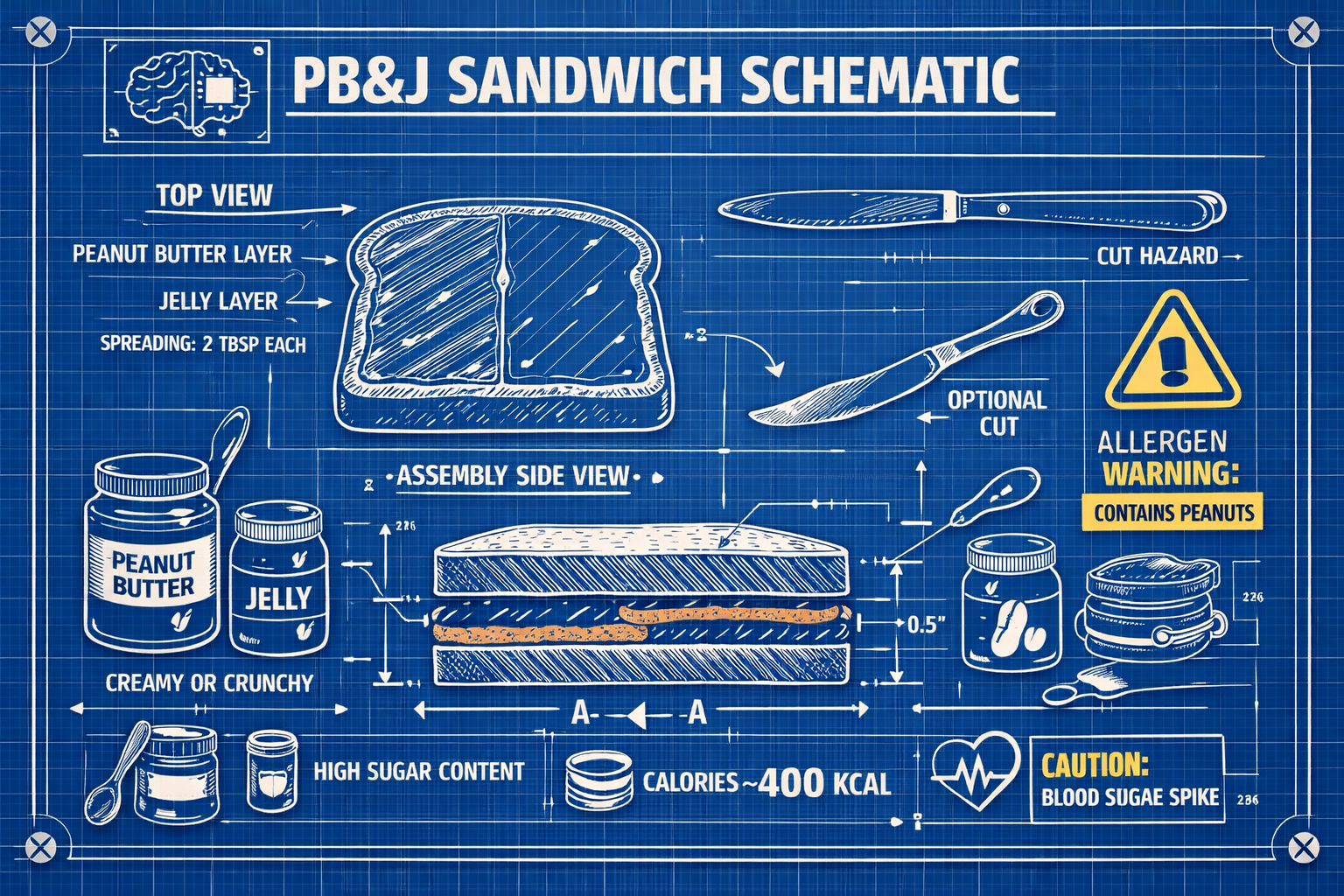
Peanut Butter and Jelly Sandwich Assembly SOP
PB&J Sandwich: Reimagining a Classic Technical Writing Exercise
If you’ve ever interviewed for a technical writing role, chances are you’ve encountered the infamous prompt:
“Explain how to make a peanut butter and jelly sandwich.”
At first glance, it seems almost insulting in its simplicity. But seasoned technical writers know this exercise isn’t about sandwiches at all. It’s about clarity, assumptions, structure, risk awareness, and the ability to communicate instructions to an audience that may take everything literally.
For this post, I decided to revisit this classic exercise using AI, not to shortcut the work, but to push the boundaries of creativity while staying grounded in real-world documentation standards. I asked a simple question:
What happens when we treat a PB&J sandwich like a high-risk manufacturing procedure?
The result is a fully structured Standard Operating Procedure (SOP) that reframes a familiar task through the lens of safety, compliance, quality control, and operational risk—concepts technical writers deal with every day in industries like manufacturing, healthcare, and regulated tech.
AI helped me explore alternative angles faster and more playfully, but every decision—structure, warnings, tone, and level of rigor—was guided by my experience with professional technical documentation.
Here is the SOP that emerged from that process.
Standard Operating Procedure (SOP)
Title: Peanut Butter and Jelly Sandwich Assembly in a High-Risk Environment
Document Number: SOP-FOOD-001
Effective Date: [Insert Date]
Revision Number: 1.0
Prepared By: [Your Name/Department]
Approved By: [Manager/Supervisor Name]
1. Purpose
This SOP provides step-by-step instructions for assembling a peanut butter and jelly (PB&J) sandwich in a high-risk environment. It includes safety precautions, quality control measures, and allergen handling procedures to ensure compliance with food safety and workplace safety regulations.
2. Scope
This procedure applies to all personnel involved in the preparation and assembly of PB&J sandwiches in [Factory/Food Production Facility Name]. This includes employees working in food handling, manufacturing, or cafeteria operations.
3. Responsibilities
- Operators: Follow the step-by-step process, adhere to safety guidelines, and report any issues.
- Supervisors: Ensure compliance with this SOP, oversee safety protocols, and provide training.
- Quality Control (QC) Inspectors: Verify that the final product meets standards for consistency, hygiene, and allergen management.
4. Required Materials & Equipment
4.1 Ingredients
- Bread (2 slices, whole wheat or white)
- Peanut Butter (2 tablespoons, smooth or crunchy)
- Jelly (1 tablespoon, grape or strawberry)
4.2 Tools & Equipment
- Butter Knife (for spreading peanut butter and jelly)
- Spoon (for jelly application, optional)
- Cutting Board or Work Surface
- Sanitized Plate (for sandwich assembly)
- Protective Gloves (optional, for allergen control)
5. Safety & Hazard Warnings
5.1 Allergen Warning
- Peanut butter contains peanuts, a known allergen. Cross-contamination must be avoided by using designated utensils and work areas.
- Employees with severe peanut allergies should not handle peanut butter.
5.2 Cutting Hazard
- A butter knife, though dull, can cause injury. Use proper grip and avoid excessive force when spreading ingredients.
- Store knives securely after use.
5.3 Choking & Sugar Risk
- Peanut butter is thick and may pose a choking hazard if consumed in large amounts.
- Jelly and white bread have a high glycemic index, which can cause blood sugar spikes, particularly for diabetic individuals.
5.4 Slip & Spill Hazard
- Any jelly or peanut butter spills must be cleaned immediately to prevent workplace accidents. Use an approved cleaning agent and designated wipes.
6. Step-by-Step Instructions
6.1 Preparation
- Wash hands with soap and warm water for at least 20 seconds before handling food.
- Ensure all materials and ingredients are within reach.
- Put on protective gloves if required for allergen control.
6.2 Assembly
- Place Bread on Work Surface
- Lay two slices of bread flat on a clean, sanitized work surface.
- Apply Peanut Butter
- Using a butter knife, scoop 2 tablespoons of peanut butter.
- Evenly spread peanut butter across one slice, ensuring full coverage but avoiding excess spillage.
- Apply Jelly
- Using a clean knife or spoon, scoop 1 tablespoon of jelly.
- Spread evenly over the second slice of bread.
- Assemble the Sandwich
- Place the jelly-covered slice on top of the peanut butter-covered slice.
- Align edges to ensure uniform structure.
- Cut the Sandwich (Optional)
- If required, use a clean, sanitized knife to cut the sandwich into halves or quarters.
6.3 Final Inspection & Cleanup
- Inspect the sandwich for proper ingredient distribution.
- Remove and discard gloves if used.
- Wash hands and sanitize the work area, knife, and utensils.
- Dispose of food waste in designated bins.
7. Quality Control Checks
- Confirm that peanut butter and jelly are evenly distributed with no excessive spillage.
- Verify that the sandwich is assembled correctly and cut to specifications if applicable.
- Ensure compliance with allergen safety protocols.
8. Troubleshooting & Waste Management
| Issue | Possible cause | Corrective action |
|---|---|---|
| Peanut butter tears the bread | Peanut butter is too thick or cold | Allow peanut butter to reach room temperature or spread using slow, even strokes |
| Jelly leaks from the sides of the sandwich | Excess jelly applied | Reduce jelly portion size and distribute evenly |
| Knife slips during spreading | Excessive force applied | Use controlled, gentle spreading motions and maintain a stable grip |
| Cross-contamination between ingredients | Shared utensils used for peanut butter and jelly | Use separate utensils or clean and sanitize utensils between uses |
9. Emergency Procedures
- Allergic Reaction: If an employee exhibits signs of an allergic reaction (difficulty breathing, swelling, rash), immediately call emergency services and administer first aid if trained.
- Injury: In case of a cut or injury, stop work, apply first aid, and report to a supervisor.
- Food Contamination: If contamination occurs, dispose of affected ingredients and sanitize the work area.
10. References & Compliance
- [OSHA Food Handling Guidelines]
- [FDA Allergen Labeling Requirements]
- [Facility’s Internal Safety & Hygiene Policies]
End of Document
Learnings: What This Exercise Revealed About AI and Technical Writing
This experiment reinforced a few important lessons about using AI responsibly and effectively as a technical writer:
1. AI is best used for perspective shifts, not final authority
The value wasn’t in letting AI “write the document,” but in using it to explore how else a common instruction could be framed—manufacturing SOP, safety-critical process, compliance-driven workflow.
2. Constraints make creativity stronger, not weaker
By imposing strict constraints—high-risk environment, allergens, injury prevention, quality checks—the writing became clearer, more deliberate, and more realistic. This mirrors real technical writing far more than casual how-to guides.
3. Simple tasks expose complex assumptions
The PB&J exercise works because it reveals how many things we leave unsaid: prior knowledge, acceptable risk, audience health, environmental context. AI helped surface those hidden assumptions quickly.
4. Technical writing is about judgment, not just structure
AI can suggest formats and wording, but it doesn’t replace professional judgment, what to warn about, what level of detail is appropriate, and what risks actually matter.
Ultimately, this wasn’t about sandwiches or AI hype. It was about demonstrating that good technical writing lives at the intersection of clarity, context, and accountability, and that AI, when used intentionally, can help us explore that space more creatively.
If you’re a technical writer experimenting with AI, my takeaway is simple:
Use it to think wider, not to think for you.